So another marathon has been and gone. This went better than expected given the volume of training not done.
The other half of RTP, Bev, had a great race finishing 3rd; she seems to like these long, hilly, off-road trials.
Anyway, the day after the race it was back to the Brighton University for more testing. One of the things they are looking at is the effect of DOMS (delayed onset muscle soreness) on performance. We all know that after a hard running effort — a marathon, or a lot of fast downhill running — DOMS can turn us into a John Wayne impressionist for a few days after. The legs can be extremely painful not only when flexing or contracting the muscles, but also to the touch. Well, the researchers did more than touch my legs I can tell you; measuring pain threshold with pressure probes pushed hard into the quads is not something I thought I’d ever be volunteering for.
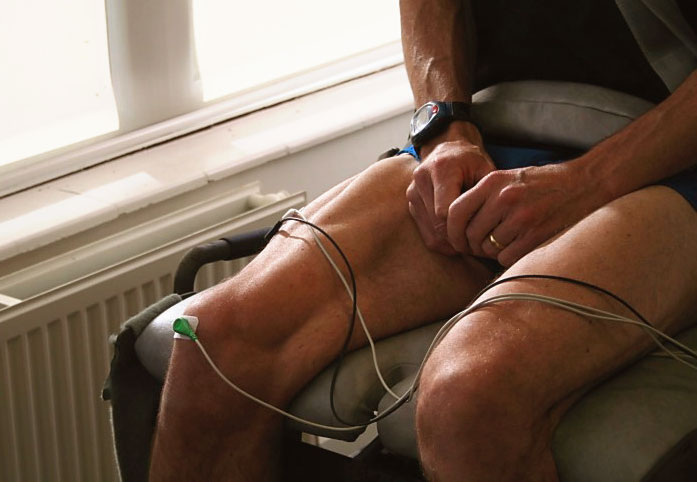
I mentioned in a previous post about the prospect of electrical stimulation of the quads. The idea behind the shock stimulation is that when the legs are mashed we don’t want to work them too hard again for a while, simply because it hurts so much to do this. Simply recording the power of the subject’s effort to contract a muscle is not a reliable method of assessing muscle damage because it does not account for the brain’s unwillingness to contract a painful muscle; hence the artificial stimulation.
DOMS is the body’s own protection mechanism. For muscles to build in strength they need to be strained a bit first, so that after a rest they come back stronger. But, during this rebuilding period they don’t want to be working too hard; it’s a bit like sleep: work hard, rest and recover, come back better prepared for next time — or something like that.
So, back to the point of the electrical stimulation — anyone seen the film The Green Mile? It was a bit like that, and more than a little unnerving. They stimulate the muscles electrically (through the head and leg) to see how much power they’ve actually lost after the marathon, compared to how the brain is protecting them. We know it hurts like crazy to run a couple of days after a marathon, but how much of this hurt and perceived lack of ability is due to the brain’s protection system? It will be fascinating to see the results of this research and also to discover whether the supplement — in this case, beetroot juice — actually lessens the onset of DOMS.
As for the rest of the last 2 weeks training, there seemed little point in cutting back for the marathon so I did manage to run some quality miles, including a 20 mile downland race and the first cross-country race of the season. Also a couple of barefoot road runs were thrown in too. It is interesting to note that both Bev and I trained hard quite close to the marathon and we both performed above expectation. This isn’t the first time that I’ve been questioning the benefits of the traditional taper.
Total miles for two weeks: 84.9
Barefoot miles: 3.4
Leave a Reply